
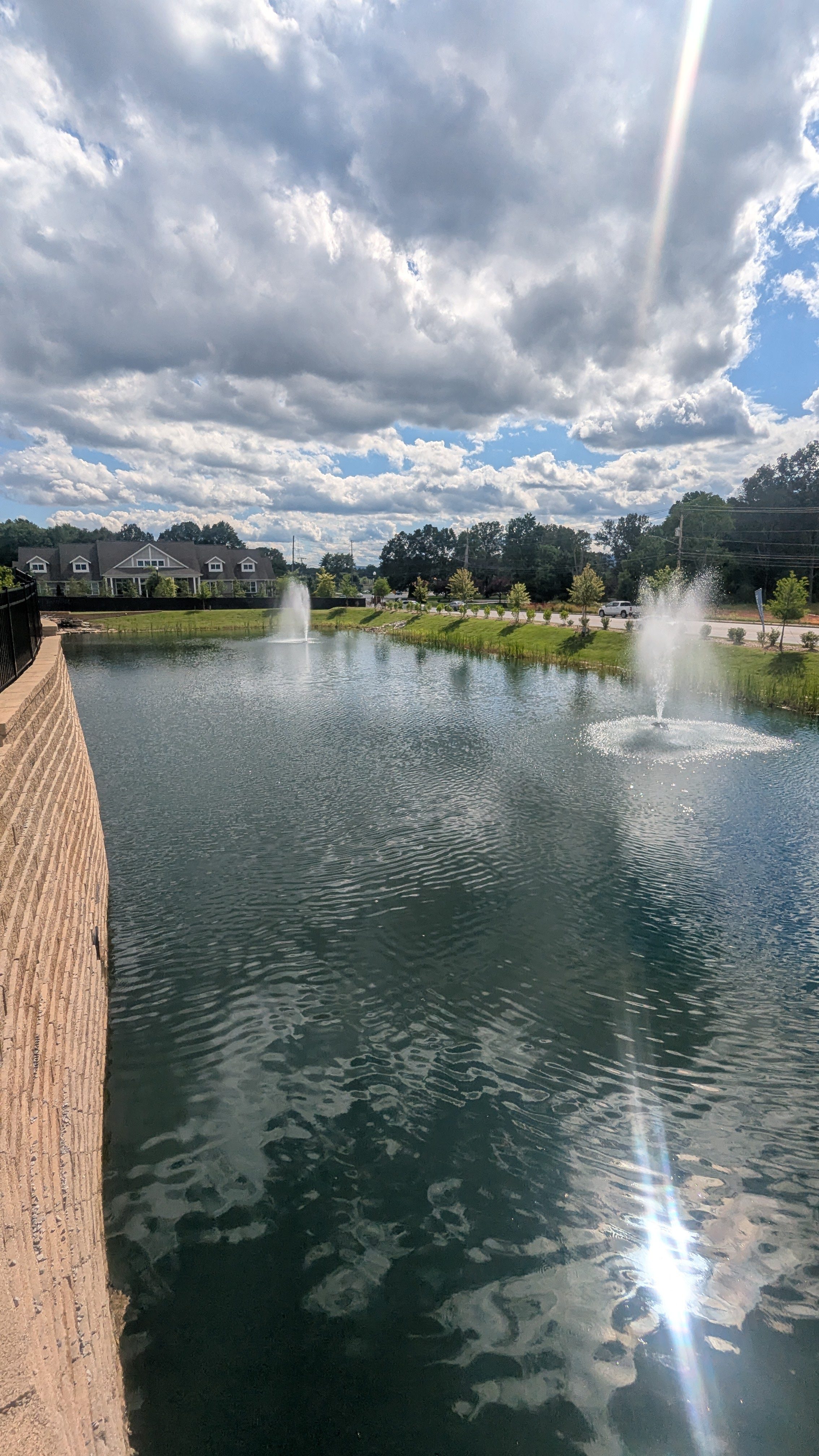
I have been working around community ponds and water features for years, and lately I have been seeing more and more retention ponds using solar-powered pumps and fountains.
At first glance, it makes perfect sense.
No electrical bill. No trenching power hundreds of feet across a property. The fountain comes on when the sun comes out, water starts spraying, and everybody driving through the neighborhood sees a nice-looking fountain in the middle of the pond.
But there is one question I think HOA boards, developers and property managers need to start asking:
Is that fountain there to look good, or is it supposed to help manage the pond?
Because those are two very different things.
The problem starts when the sun goes down
Here is the part I don’t think most people realize.
During daylight hours, algae and aquatic plants produce oxygen through photosynthesis.
Then the sun goes down.
Photosynthesis stops.
But everything living in that pond doesn’t suddenly go to sleep and stop using oxygen. Fish are using oxygen. Plants are using oxygen. Algae are using oxygen. Bacteria breaking down leaves, muck and other organic material are using oxygen.
So throughout the night, the pond’s dissolved oxygen level can continue dropping.
In fact, dissolved oxygen in a pond is normally lowest around dawn, after the pond has gone the entire night without producing oxygen through photosynthesis.
Now think about what a direct-solar fountain does.
The sun goes down…
and the aeration shuts off too.
That is the exact opposite of what I would want if I were depending on that equipment to help maintain dissolved oxygen.
And cloudy weather can make the situation even worse. A heavily overcast day can mean reduced photosynthesis in the pond while also reducing the output of the solar equipment.
So now you potentially have less natural oxygen production AND less mechanical aeration at the same time.
That doesn’t mean every pond is going to have a problem every time there is a cloudy day. Ponds are ecosystems and there are a lot of variables involved.
But it does mean I would never look at a fountain spraying water at 2:00 on a sunny afternoon and automatically assume the pond has adequate aeration.
I am not against solar power
I want to make this part clear because I don’t want this article to sound like I’m saying solar fountains are junk.
I’m not.
Solar can make a lot of sense in locations where electricity isn’t available. And if the purpose is primarily appearance, a solar fountain may be perfectly fine.
Solar can also be used to operate a legitimate aeration system if it is engineered correctly, including enough solar capacity and battery storage to continue operating when sunlight isn’t available.
My problem is relying on a sunlight-only system as the primary aeration strategy for a community pond that is already struggling with water-quality problems.
That’s where I think people can get into trouble.
A fountain and an aeration system are not necessarily the same thing
This is another big misconception.
People see water shooting six or eight feet into the air and think:
“Look at all that oxygen going into the pond.”
Some oxygen exchange absolutely is taking place.
But that doesn’t automatically mean the entire pond is being properly circulated.
A retention pond might have thousands or even millions of gallons of water in it. Depending on the depth and shape of the pond, you can have completely different conditions near the surface than you have several feet below it.
Water can stratify into layers.
The upper portion may have decent oxygen while water near the bottom becomes oxygen poor.
And that bottom area is important.
That is where leaves, dead algae, grass clippings and other organic material accumulate and decompose. If conditions near the bottom become anaerobic, decomposition changes and nutrients such as phosphorus can be released from the sediment back into the water.
Guess what phosphorus helps feed?
More algae.
Now we are starting to chase our tail.
We treat the algae.
The algae dies.
The dead algae becomes more organic material.
Bacteria break it down and consume oxygen in the process.
Nutrients become available again.
Then we get another algae bloom.
So we treat it again.
If we never address why the pond keeps producing excessive algae, all we are doing is treating the symptom.
The worst time to lose aeration may be the exact time a solar fountain turns off
This is really the point I want people managing community ponds to understand.
If I had a pond where mechanical aeration was actually needed, and for some reason I could only operate that aeration for part of the day, nighttime would be extremely important.
That isn’t just my opinion.
Pond-management guidance from Oklahoma State University specifically points out that when aerators aren’t operated continuously, they should generally be operated at night because that is when natural oxygen production from pond plants has stopped.
Penn State’s pond ecology guidance explains the same basic process: plants and algae produce oxygen during daylight, but at night respiration continues and oxygen can become deficient by dawn.
So when I see a community pond with an algae problem and its primary source of water movement is a solar fountain that stops operating every evening, that immediately gets my attention.
Aeration still isn’t a magic cure for algae
There is another side of this that is equally important.
You can’t simply throw a bigger aerator in a nutrient-loaded retention pond and expect every problem to disappear.
Where are the nutrients coming from?
Is lawn fertilizer washing into the pond?
Are grass clippings getting blown toward the shoreline?
Is there excessive goose activity?
Is there a huge amount of muck and decaying organic material on the bottom?
Has the shoreline become completely overtaken with cattails or other vegetation?
Is stormwater carrying sediment and nutrients into the pond every time it rains?
How deep is the pond?
How much of the water column is actually being circulated?
Those are the questions I want answered.
Because the fountain is only one piece of the puzzle.
Look at the pond as a system
This is probably the biggest thing I wish more HOAs and developers understood about retention ponds.
A pond is an ecosystem.
You can’t manage oxygen separately from algae, algae separately from nutrients, nutrients separately from runoff, runoff separately from shoreline vegetation, and shoreline vegetation separately from organic buildup.
They all affect each other.
So before spending thousands of dollars treating algae over and over again, replacing fountains, adding chemicals or installing equipment, somebody needs to look at the entire pond and ask:
What is actually causing the problem?
Sometimes the answer may include better aeration.
Sometimes it may be nutrient management.
Sometimes vegetation needs to be controlled.
Sometimes years of accumulated organic material are part of the problem.
Usually, it is more than one thing.
And if the only reason a solar fountain was installed was to make the pond look better, there is absolutely nothing wrong with that.
It just shouldn’t automatically be confused with a properly designed pond-management or aeration system.
That distinction can make a pretty big difference in what that community pond looks like five years from now.
Harry Jones
Nooga Waterscapes
Chattanooga, Tennessee
Leave a Reply